

Polymarket is the largest crypto prediction market, but it has limitations like idle capital, fees, and restricted market creation. Here are three best alternatives:
Prediction markets have evolved from a niche idea into a multibillion-dollar industry where users can earn by correctly predicting future events. These events range from geopolitics and national elections to crypto prices, sports, and niche cultural moments.
Two major platforms currently dominate the space: Kalshi and Polymarket. Their success has turned founders into billionaires and created large profits for early users.
Kalshi operates as a regulated, US-based platform that focuses on traditional event contracts. Polymarket, meanwhile, is the dominant crypto-native prediction market with deep liquidity and a wide range of markets.
Most Web3 users naturally gravitate toward Polymarket. However, several newer platforms are experimenting with different models that may offer better incentives, lower fees, or additional features.

Polymarket is a decentralized prediction market built on the Polygon blockchain and powered by the UMA oracle for dispute resolution.
Users trade shares that represent the probability of an event happening. Shares are priced between $0 and $1, where the price reflects the market’s estimated probability.
For example:
Users can sell their positions before resolution to capture profit from price changes or hold them until the event concludes.
Polymarket is widely credited with bringing crypto prediction markets into the mainstream.

Despite its dominance, Polymarket has several limitations.
Users often lock large amounts of stablecoins while waiting for events to resolve, without earning yield on those funds.
Users cannot freely create markets themselves and benefit directly from doing so.
Countries like France, Portugal, the Netherlands, and several others have blocked Polymarket, as the authorities believe it’s a gambling platform.
Taker fees can reach around 3.15%, which is relatively high compared with emerging competitors.
These limitations have created room for alternative prediction market platforms to experiment with new models.
The platforms below attempt to improve on Polymarket through better incentives, new trading models, or additional features.
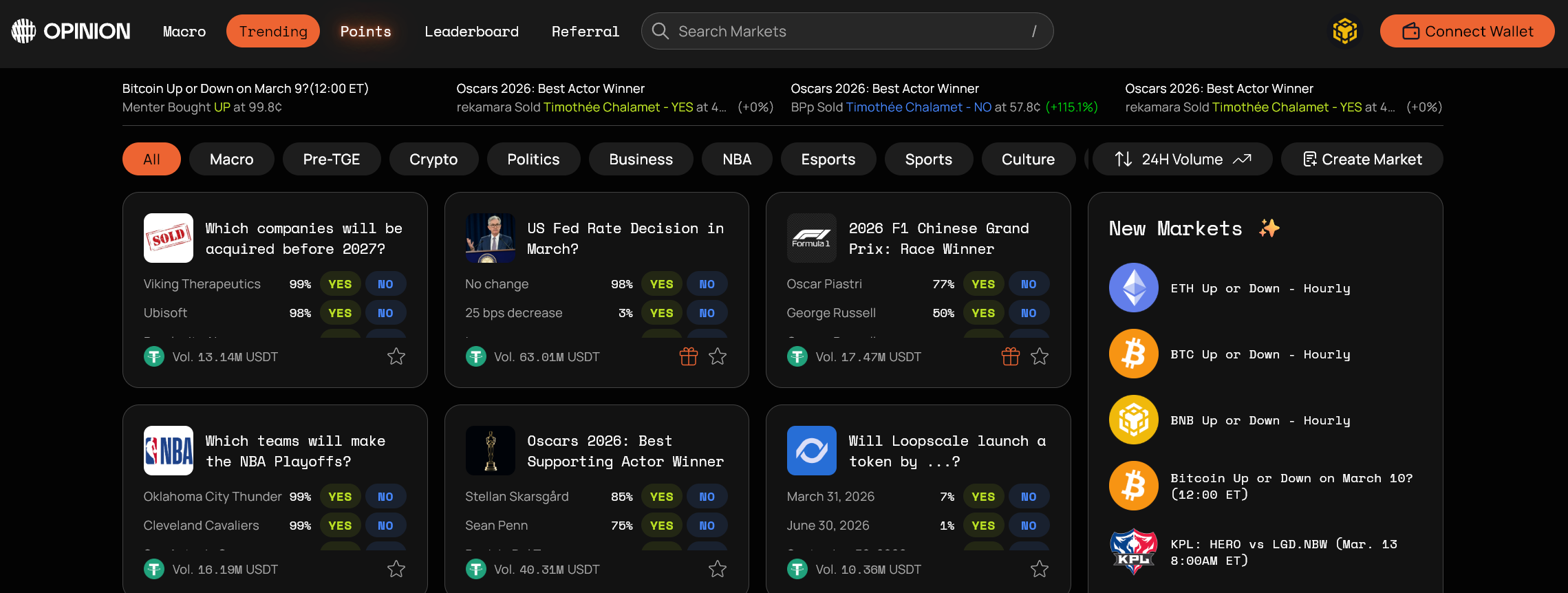
Opinion.Trade is a BNB Chain prediction market that introduces AI-assisted settlement systems and combo markets, which allow traders to combine multiple predictions into a single bet.
Key features include:
The platform rewards users for trading activity, referrals, and participation, which may lead to future token incentives.
Predict.Fun introduces a major innovation: yield-bearing prediction capital. The platform is backed by YZI Labs, formerly known as Binance Labs.
Instead of sitting idle while markets resolve, users’ stablecoins can generate DeFi yield during the prediction period.
Key features include:
Users can earn interest on funds used in longer-term predictions, which improves capital efficiency compared with traditional prediction markets.
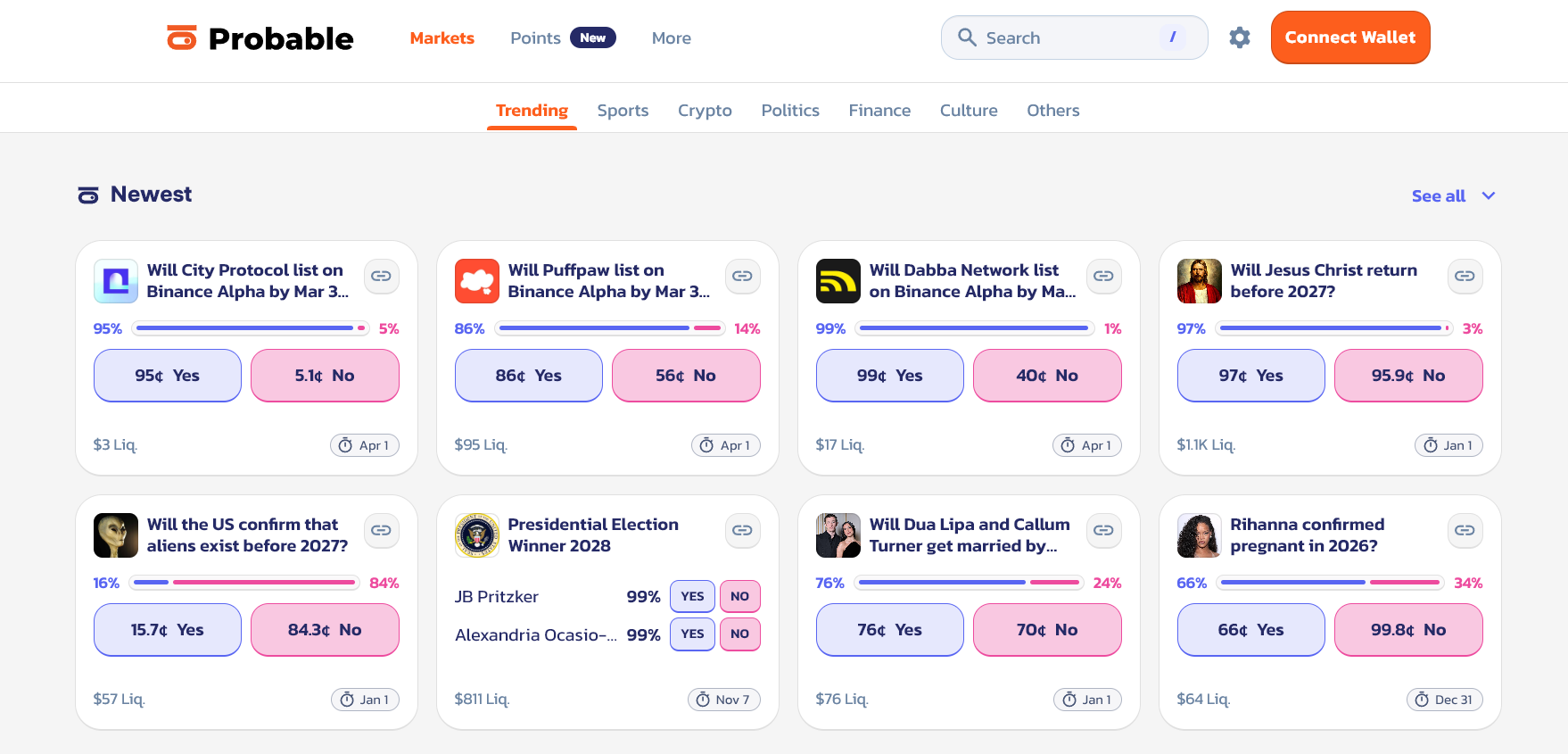
Probable focuses on accessibility and lower friction trading.
Key features include:
The platform uses infrastructure from PancakeSwap to improve trading performance and liquidity access.
Azuro is not a prediction market itself but an infrastructure protocol that powers several prediction-style applications.
It provides shared liquidity across multiple apps, allowing for:
Azuro also has its own token, which users can stake for yield while supporting the broader ecosystem.
| Feature | Polymarket | Opinion.Trade | Predict.Fun | Azuro |
| Model | Order Book | AI Order Book | Yield-Bearing | Liquidity Pool |
| Best For | Politics / Culture | Combo Predictions | Capital Efficiency | Sports / High Volume |
| Network | Polygon | BNB Chain | BNB Chain | Multi-chain |
| Passive Yield | No | No | Yes | No |
Blockchain technology enables prediction markets to operate without centralized control.
Key advantages include:
Prediction markets also turn information and probability into tradable assets, which many consider one of Web3’s most interesting use cases.
Polymarket remains the dominant crypto prediction market. However, new platforms are experimenting with improved incentives, better capital efficiency, and new trading models.
As prediction markets continue to grow, these emerging platforms may capture significant market share.
Many of them also run points programs that could eventually translate into token airdrops, making early participation potentially valuable.
Exploring multiple platforms may offer the best opportunity to understand this fast-evolving sector.

Comments (0)